Few UK cities have a bigger disparity between population size and the local football club’s league position than Chelmsford. Spencer Gore has a plan to change that. He spoke to Iain Macintosh.
It’s a cold, gloomy October afternoon in Essex but the Dunmow Group Community Stadium is fizzing with excitement. Chelmsford City have just fought back after conceding an early goal, Lyle Taylor’s exquisite free-kick has restored parity, and now they are taking control. Worthing, a strong outfit in this National League Conference South, are on the back foot, trying to hang on for the break.
And then a quick free-kick, a long hoof over everyone, leaves Chelmsford goalkeeper Dillon Addai stranded outside of his area. He tries to clear the ball, but succeeds only in kicking Worthing’s Teddy Jenks. Referee Jordan Crossley’s hand is in his back pocket as he runs across the pitch, frantically fishing for his red card.
At the back of the main stand, Spencer Gore lifts the plastic bottle of mineral water he’s been fidgeting with since kick-off as if he’s going to hurl it onto the pitch. He settles instead for a brief burst of industrial language. He knows, as do nearly 2,000 Chelmsford City fans, three points are a big ask now. But the difference between them and him is that while they support the club, he owns it. And now his goalkeeper is walking off the field, head hung low, and the Dunmow Group Community Stadium is no longer fizzing.
Gore, who made his money in healthcare publishing, bought a 60% majority stake in 2024 after a long relationship with the club. He immediately raised eyebrows when he set a target of Premier League football by 2038, but his belief is unwavering.
“If you rank football teams in terms of their town’s populations, Chelmsford is a Championship team at least,” he says before kick-off. “It’s an affluent area, it’s growing quickly, it’s got huge potential.”
He’s right. There can be no greater exemplar of Chelmsford’s recent transformation than the market place that has sat underneath her grey, brutalist multi-storey car park for over 50 years. Once a dark and sepulchral space, choked with thick cigarette smoke and the ringing shouts of traders, it’s now clean, brightly lit and has a champagne bar called ‘Bubbles’. Chelmsford has gone up in the world.
“It’s my local team,” says Gore. “I used to watch them at the old stadium in New Writtle Street. When I sold my first business, I came down here to help with commercial stuff and it went from there. I was on the board a couple of times, I tried to buy them four or five years ago.”
That old stadium is still the source of much regret. Located right in the centre of town, it boasted a capacity of just over 20,000 in the frustrating post-war years when the club made 17 unsuccessful attempts to be elected into the Football League. (Note for young readers: Until 1986, there was no direct pathway between the Football League and non-league hinterlands, there was the flawed re-election process that left big non-league clubs like Chelmsford and Kettering out in the cold.)
The stadium and its prime location was sold off in 1997. The club began a nomadic spell of ground shares around Essex before they returned to Chelmsford in 2006 at this council-owned arena in the very north of what is now a certified city.
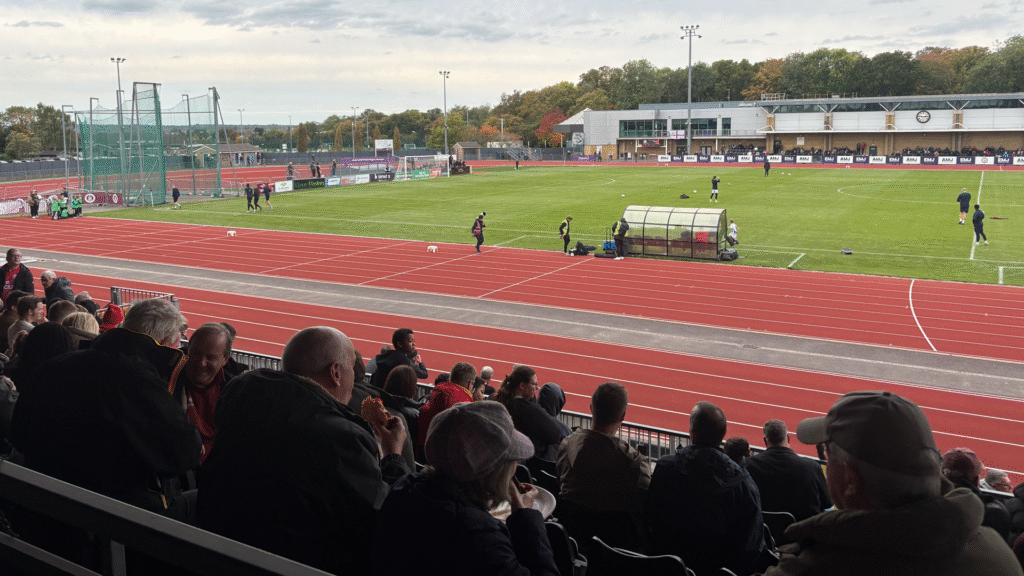
But in spite of the city’s sudden growth, Gore faces challenges if he’s to achieve his aim. This stadium is on the poorer fringes of Chelmsford, they’re no longer nestled in the affluent centre. And it’s a multi-purpose complex. The pitch is surrounded by an athletics track. There’s a long jump pit and a hammer throwing circle.
“You play the cards you’re dealt,” says Gore. “We’d all love to have a big stadium in the middle of the town centre, but it isn’t there because of historical reasons. But look at what we have got: we’ve got a phenomenal clubhouse, we’ve got a really good stand and terracing areas right behind the goals. We’ve got a great relationship with the council, so we’re lucky to have this facility.”
The clubhouse is packed long before kick-off. The new ownership shrewdly introduced a ‘lager lane’ to speed up service to those with uncomplicated orders. Control of the club shop has been wrested back too, having been outsourced by the previous administration in an agreement that saw little benefit to the club. Now it brings in five figures of revenue a year.
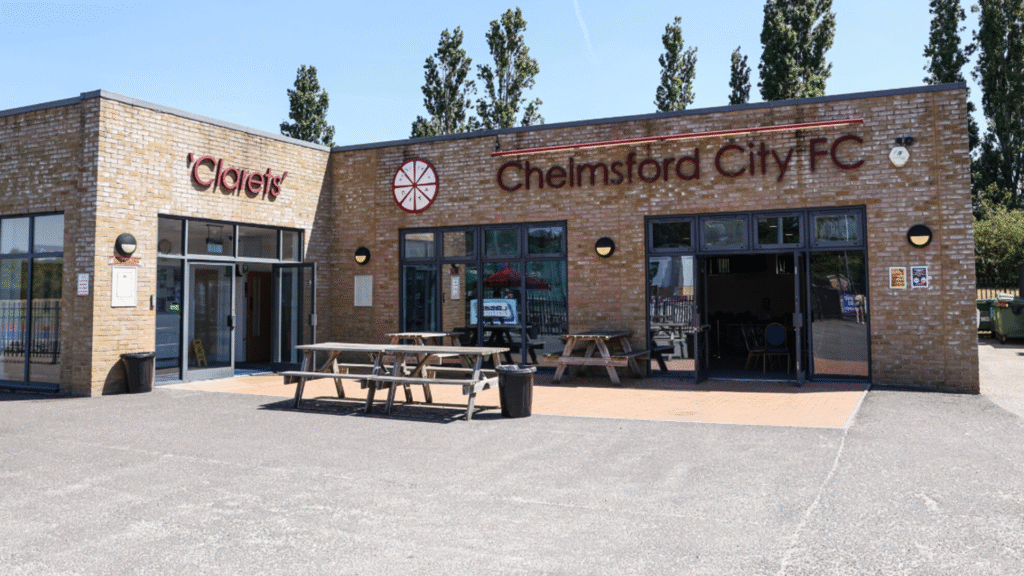
As supporters arrive, one man strides purposefully from trouble spot to trouble spot, first helping to fix a turnstile’s malfunctioning payment system, then briefing stadium security, then heading back to the clubhouse and jumping behind the bar to pull pints and alleviate a queue that threatens to stretch out of the front door. Keith Moule was Director of Operations at Gore’s company EMJ before being deployed into this very hands-on role at Chelmsford. An elite athlete who represented his nation and broke records in canoeing, he operates as a sort of nuclear-powered club secretary who you suspect never sleeps, but simply drops into standby mode.
“For the first six months,” he says, “we just watched and learned. Then we tried to find ways to do things better. People might say ‘but we’ve never done it like that before,’ but the club has been bouncing around at the same level for years. So if we come in and just do the same thing, what do you think is going to happen? The same thing.”
Gore had to make one major change in the summer when well-regarded manager Robbie Simpson departed to focus on his work assisting former players with the transition into normal life.
“We had people applying for the job before the news had got out,” said Gore. “We spoke to some really interesting people, ex-Premier League players, but we had set criteria. We wanted someone who was ambitious, someone who had led a team to promotion, and someone with experience in the league above.”
Ange Harrop had done all of that up the road at Braintree, taking them up from this level before being sacked early in his first National League season.
“He was the first person I sat down with,” says Gore. “He ticked all the boxes there and then. I wanted to speak to others to compare and get some benchmarks, but he was the man.”
Harrop has been granted considerable freedom to build his squad.
“I don’t go into the changing room,” says Gore. “That’s their space. I know my boundaries. At the start of the season, Ange was given a budget and I said, ‘You sign whoever you want. If there’s anyone controversial, we’ll talk it through, but otherwise it’s your budget. If you want to sign 10 players and use all your budget on that, it’s your choice. If you want 20 and you use all your budget like that, it’s your choice.”

Harrop signed multiple players including former Nottingham Forest striker Taylor and returning hero Ricky Holmes who left for the bright lights of the Football League back in 2010. From the opening exchanges, it’s clear he’s worked quickly. Chelmsford are organised, well-drilled and have a distinctive, combative style. They push high up the pitch and are relentless in their pressing.
They concede after nine minutes when opposing winger Toby Byron goes full non-league Messi, turning poor Kian Ronan inside out before sliding the ball in for Joel Colbran to convert. But they regain their composure quickly, level through Taylor, and are very much in control when Addai is dismissed.
Reduced to 10 men for more than half the game, Chelmsford are dogged, but Worthing take the lead on the hour, scoring from a disputed corner, something that only fuels the home side’s sense of injustice. Harrop’s side refuse to go quietly, but time slowly ebbs away and they lose 2-1.
Stood at the back of the stand (“I go there when I’m stressed or when my knee hurts,”) Gore is grim-faced. He walks down the steps with his family, shakes hands with players and officials, then trudges towards the director’s lounge, which rather unfortunately means trudging past the away dressing room, its loud music and sounds of jubilation.
“I’m gutted,” he sighs 10 minutes later. “I was absolutely buzzing this morning, thinking this is why I bought a football club, this is better than anything. And then you come in and that happens and you think, why am I punishing myself and spending a fortune for the privilege of punishing myself? It’s bad enough watching your team lose when you don’t own them, but…” he says, collecting himself, “…you have to listen to the signal and ignore the noise. It’s annoying, it’s frustrating, but if you get in your car and set off on a long journey, you’re going to find some roadblocks and some detours. This is just a roadblock. We’ve got a long-term plan – this is just a little step on the way.”
Do moments like this make him regret targeting the Premier League by 2038; something he knew would be used as a stick to beat him?
“I’d rather get beaten by that stick than be unambitious and say by 2038 we’re going to still be in the National League South,” he says defiantly. “If I’m going to do anything, I’m going to do it to the best of my ability. I don’t know why anyone wouldn’t want to aim for the Premier League. It doesn’t mean it’s going to happen but that’s the dream. We’ve got a plan we’re working towards. Why on earth would you start anything and not want to be the best version of yourself?”