With West Ham in the bottom three and seemingly on the brink of sacking their latest manager, Iain Macintosh takes a minute to ask what West Ham actually are.
There are many things that come to mind while watching West Ham these days. Things like ‘Why are they all marking the near post when everyone’s at the back post?’ and ‘Where’s that Brazilian kid they spent £25m on?’ Mostly though, the thing that comes to mind is ‘What are they?’
We know what they are not. They are not, and have not been for some time, an academy of progressive football. Every now and then they try that gambit, it goes horribly wrong and they have to call David Moyes or Sam Allardyce to sort it all out.
They no longer seem to boast an assembly line of English talent. Oliver Scarles and Freddie Potts, their current hopefuls, have been allowed just 45 minutes of football between them this season.
They are not modern day masters of data like Brentford or Brighton who both finished above West Ham last season. They are not the skilled wheeler dealers of the transfer market that they used to be. In fact, some of their recent business has them cast as the sort of little old lady who finds herself paying £40,000 to a nice young man to clean her driveway.
Theirs is a crisis of branding as much as it is of football. We don’t know what they are because they don’t know what they are.
Supporters will put up with a lot, as the 62,000 supporters who went to the London Stadium on Saturday will doubtless attest. But you need to sell them a vision. Excluding the social media blowhards, as we always should, most fans will accept setbacks if there is a pathway to better times.
Sure, we lost, but we played well and I was entertained. Sure, we lost, but look at all those local kids on the pitch. Sure, we lost, but that Peruvian left-back looked decent, didn’t he? And I’ve heard Chelsea are ready to bid £60m…
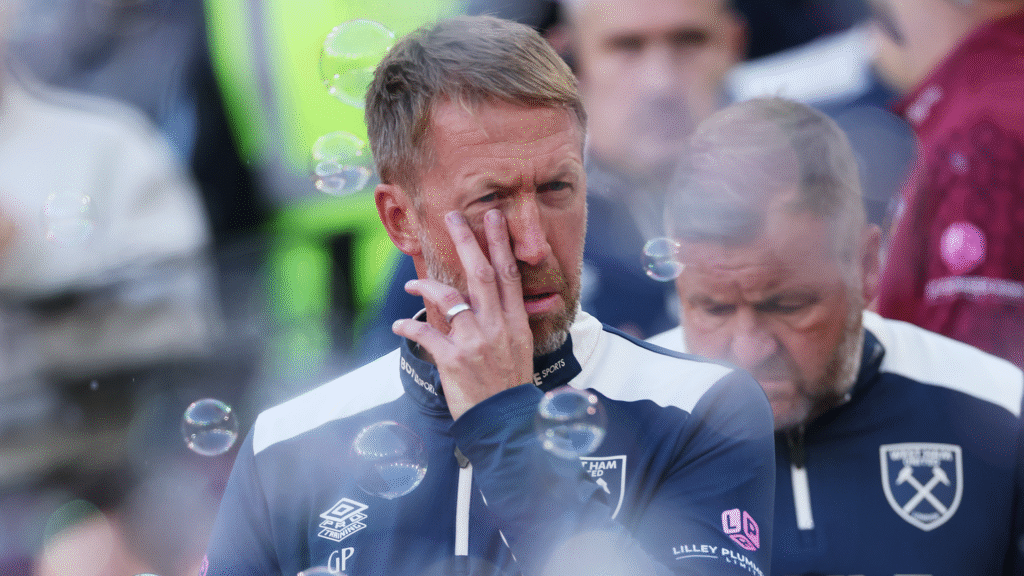
But where is West Ham’s pathway? Everything seems so short-term. David Moyes, who won the Conference League and secured three top ten finishes, left in the summer of 2024. He was replaced by Julien Lopetegui who brought his entire staff, lasted just 20 league games, and was summarily dismissed in the New Year. The Hammers were so unsure about replacing him with Graham Potter that he was initially only offered a six-month contract before he haggled his way to two and a half years. And now he looks to be on the brink too.
In 2023, West Ham decided to adopt the ‘technical director’ model and hired Tim Steidten, but he clashed with manager David Moyes to the extent that Moyes banned him from the training ground. Steidten appeared to have won the power battle when Moyes departed, but then he was axed too when Potter arrived.
West Ham have known they’ve needed a new striker for some time. Last year’s solution was to spend nearly £30m on Niclas Fullkrug. He’ll be 33 in February. This year’s solution was Callum Wilson. He’ll be 34 two weeks later. They should have a joint birthday party.
Goalkeeper Lukasz Fabianksi, now 40, was released in the summer and re-signed last week. Now that isn’t a serious issue. Most clubs have a very senior pro as a third goalkeeper and West Ham were not unduly affected in his absence. But it doesn’t suggest that there’s a lot of forward planning going on over there.
West Ham are the arguably the club with the greatest disparity between their level of potential and their current level of competence. They have everything. A giant free stadium, a nice training ground, a massive supporter base whose loyalty inexplicably holds, a London location to attract foreign players. A good theme tune. Ray Winstone. A nice, cleanly designed kit. Probably a good pie selection. I don’t know, I haven’t been in a while. But you’d think so, wouldn’t you?
It’s hard to keep up with the superpowers now, especially when so many of them are bankrolled by nation states, but there is no reason why West Ham shouldn’t be able to at least trade blows with the likes of Spurs and Chelsea. Instead, they’ve been humiliated by the pair of them in a matter of weeks. On Saturday evening, they shipped goals number nine, 10 and 11 of the season. This does not bode well.
But on the pitch, West Ham are not completely inept. And this may be the nicest thing that anyone has said about them for some time.
They actually held their own against Spurs in the first half and showed flashes of something that seemed to approach the sort of progressive football desired by the fan base.
In the 15th minute Malick Diouf, their 20-year-old left-back, won a crunching challenge inside his own half. He slipped the ball to Matheus Fernandes who, instead of panicking and trying to break on his own, rolled the ball back to his own defensive line to buy everyone else the time to move up the pitch. That allowed Kyle Walker-Peters, a rare example of a shrewd signing here, to exchange a neat pass with Fernandes and then underlap his teammate, freeing up Jarrod Bowen to dart out wide. So far, so pretty. Bowen’s ball into the box was perfect and either Fernandes or Lucas Paquéta should have done far better with the finish. It was a great move. If Liverpool or Manchester City had done this and scored, you’d never hear the end of it.
But what’s confusing about West Ham is that they don’t do that more often. Their game is characterised by a complete lack of consistency. Sometimes they build up from the back like this, sometimes they smash it long (as they did so here 69 times with a success rate of just 40%). Out of possession, they chose to drop deep and try to swallow up Spurs, except they didn’t all do that. Fernandes was repeatedly spotted trying to execute a doomed one man press.
It was far easier to spot patterns of play with Spurs and their manager has only been in place for five matches. Potter has been there since January. Surely some sort of style should be visible by now even, as with Ruben Amorim at Manchester United, it’s not working.
This is not to say that West Ham’s struggles are entirely Potter’s fault, even if you could make the argument that he doesn’t have much in the positive column. Graham Potter is not a bad manager. We don’t have any evidence that he is a good one, at this level at least, but we know that he is not a charlatan promoted above his natural altitude.
What we don’t know is how West Ham get out of this funk. This season is not last season. The bottom three are not going to be welded into place by Christmas. If the Hammers don’t offer some evidence of the sort of long term planning that has elevated smaller teams than themselves, they will be relegated. They are big, but they are not too big to go down.