From Ancient Greece to modern football, the muscular man has always been in-demand. Danny Kelly examines the historical precedents of the Premier League’s Hercules era.
Who’s up for a spot of Greek philosophy? Thought not. Anyway, ever since Heraclitus had his brainwave, about 2500 years ago, we’ve understood that the natural way of things is Change. Not stasis, not status quo, but continual, inevitable, irresistible Change. In recent times, new technologies have madly accelerated the speed of change, like the Starship Enterprise going into warp-drive. It’s dizzying, sometimes disconcerting, but you can’t do much about it; you can’t change Change.
It’s tempting to pretend that the Premier League is immune to all this. After all, the stadia are full, every game is (according to the pre-match hype-folk) a certain classic, and the money continues to cascade in. But closer inspection reveals that the game, at the top level, is, quite suddenly, going through some pretty profound alterations.
The first big shift is in the world of tactics. This still-young season has seen the widespread adoption of a raft of stratagems that even a few months ago would have been considered outmoded, unworkable or just plain daft. Desperate to escape the clutches of the high press (and its ugly sister, passing the ball aimlessly around at the back), teams have started to mix up their passing range, to play the long ball. Midfielders are getting cricked necks watching the ball sail over their heads. Defenders are having, for the first time in 15 years, to consider the space behind them. And crowds, used to treating any pass lengthier than five yards with a derisive howl of “hooooof”, are becoming reacquainted with the beauty, and effectiveness, of the long-distance pass.
The re-emergence of more direct play is reflected in smaller ways too. Set pieces are back! Gone is the universally despised (by fans, if not coaches!) short corner, replaced by an inswinging missile aimed directly at the wrestlemania happening in the six-yard box. Back too is the previously-thought-extinct long throw. So neglected had this attacking weapon become that only the most silver-haired could actually name the last person to regularly use it in the upper echelons. Come on down… Rory Delap!
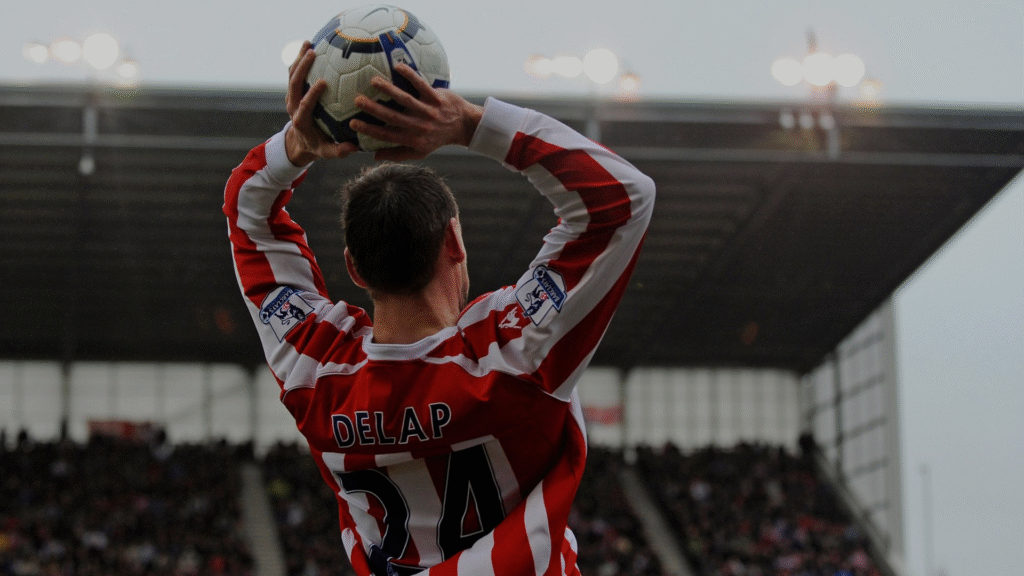
But all this isn’t so much a change of tactics, as a change of attitude. 15 years ago, a battle was raging for the soul of football. In one corner was the intricate, infinite passing of Barcelona and the Spanish national team. In the other, the more pragmatic, robust approach largely favoured by British coaches and represented, perhaps amazingly, by the workaholic yeomen of Stoke City. And while there is no morally correct way to play football, the argument was won – totally and utterly – by the Spaniards. The rapier defeated the cudgel; brains bashed brawn; tiki-taka routed bish-bash-bosh.
So complete was this victory that a generation of coaches emerged for whom there was only one way to play the game. Even the great Arsene Wenger dismantled his physically powerful Arsenal side. He replaced it with a team that was technically gifted, aesthetically pleasing and much less successful. In truth, football was afflicted with a contagious snobbery. Anything that diverged from the Barca-path (neanderthal throwbacks like far-post corners, long passes, or aggressive throw-ins) were frowned upon and derided. It has taken a decade and a half (and the realisation that not every team is bejewelled with the simultaneous presence of Messi, Xavi, Iniesta and Villa) for the scales to fall from hypnotised eyes. Orthodoxy is out; invention and variety is in; the game is much better for it.
The second great change currently sweeping through the top tier of English football is probably also related to the discovery that not everyone can be Barcelona 2011. But whatever the reasons, it is undeniable that in the last 18 months the Premier League has replaced France’s Ligue Un (and possibly the English Championship), as the most physical competition in the world. Strength, pace, and athleticism are at an all-time premium; clubs are buying bigger and bigger players; an average fan gazing out at the pitch would be forgiven for thinking that they’d been teleported into an episode of Land Of The Giants.
Don’t get me wrong. Footballers have never been your average physical specimen. I’ve had the pleasure of working with numerous ex-pros, and these are not ordinary chaps. Alan Brazil, with his legendary love of a tipple and a Chinese, has become a kind of poster boy for unhealthy living. But he has a handshake like a vice, and forearms like Christmas hams; beneath the upholstery is significant muscle. For years, I partnered ex-West Ham legend Alvin Martin on air. Occasionally, after a decent show, I’d clap him on his 60-year old back; it was like slapping a JCB. And don’t get me started about Stuart Pearce!

Equally, history suggests that the game’s geniuses have tended to be, well, shortarses. Jimmy Greaves, Gerd Muller, Diego Maradona, Lionel Messi, Luka Modric, Pele… the list goes on and on, footballing gods in no danger of hitting their heads on the doorframe. Indeed it’s possible to put together an all-time XI of chaps who would be the last to know that it’s started raining, but who would be unbeatable. Let’s do it. 3-4-3 formation, no makey-uppy positions: Jorge Campos (5’ 7”): Fabio Cannavaro (5’ 9”), Franco Baresi (5’9”), Roberto Carlos (5’ 6”); Luka Modric (5’ 8”), Zico (5’ 8”), Diego Maradona (5’ 5”), Garrincha (5’ 7”); Lionel Messi (5’ 7”), Pele (5’ 8”), Jimmy Greaves (5’ 8”). What fun, and what a team! Favourites for the next World Cup? Short odds, certainly.
So there will always be a place for the truly talented titch. But increasingly EPL coaches are looking to augment these wizards with an array of the muscular, the mighty and the multistorey. Goalkeepers, obviously, are now routinely gargantuan, but it’s happening all over the pitch. The marvellous Brian Clough once thought that the tall, gangly Viv Anderson was “the wrong shape” to be a full-back; now nobody bats a lash as Dan Burn or Liam O’Brian loom and lumber down the touchline. Centre backs are monstrous athletes; Micky Van De Ven is built like a giraffe but runs like a cheetah. Midfield has become a battleground for monsters. And now virtually every top side has tooled themselves with a big fella up top; Haaland at Manchester City, Sesko at United, Woltemade at Newcastle, Gyokores at Arsenal, Isak at Liverpool, Mateta at Palace. No coincidence that the two best teams in England just now, Liverpool and Arsenal, are the biggest.
This will, one suspects, continue until the cycle of change kicks in again. In the meanwhile, we are stuck with a horrible irony. Traditionally, one of the advantages clubs from the lower leagues had when they met their top-flight cousins was that they were good at set pieces, ferociously physical, and equipped with a load of large lads, “units”.
That edge no longer exists. With the exception of Grimsby’s wonderful win over hapless Manchester United, the recent spate of Caribao Cup matches saw the elite clubs, with their huge players, handily dismantle their lower league brethren. In the land of the giants, there may be no more giant-killing.