Welcome to Desert Island Floppy Discs where we return to some of the greatest video games of the past 40 years.
I was not at all convinced by the concept. It didn’t sound like my sort of thing at all. I liked sports games, I liked racing games, I liked games where you built armies and tried to conquer the world. I felt, on balance, that the opportunity to set local bus timetables was one that I could safely ignore.
Besides, it was 1994. There was just enough hair on my chin to get me served in pubs. Was I really going to sit inside and play something that looked suspiciously like a Thomas the Tank Engine simulator?
“Just try it,” said my friend. “Give it an hour.”
I sighed, we made the exchange. He slipped me the discs in the common room. Transport Tycoon for Cannon Fodder. Hardly a fair exchange, I felt.
I gave it an hour.
The hour became six hours. The time became ‘past midnight’. But I couldn’t stop. How could I stop? With the steady revenue I’d generated from my bus network, I’d invested in a sprawling rail network. And with the increased earnings from trains hauling lumber and coal across the map, I could buy an aeroplane! And it was the 1940s now, people were inventing new aeroplanes. I can’t sleep now. I need more aeroplanes.
And so it goes. So it always goes.
Transport Tycoon was billed as a business simulator, but it’s not; it’s a train set with unlimited pieces in a vast room where you don’t have to work around the coffee table. And then it’s a giant box of toy trucks. And then some boats and planes too, just for fun.
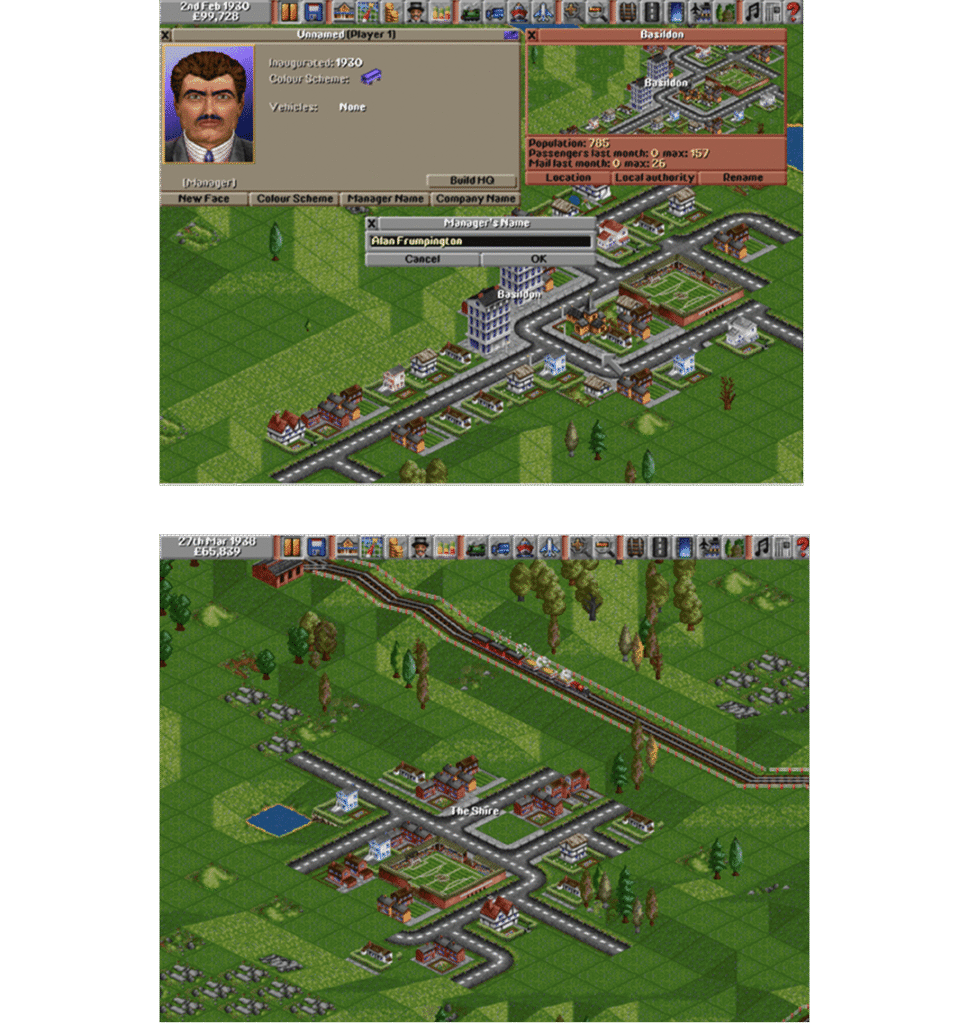
You open in 1930, gazing God-like across miles and miles of isometric landscape filled with small towns, industrial resources and industrial processing points. Stick with me, it gets better. Every industrial processing point requires an industrial resource. A power station requires coal, a lumber yard requires wood etc etc.
All you have to do is link the resource to the processing point by road, build a couple of lorry bays, build a suitable lorry and then tell it to go from point A to point B, which it will dutifully do until you tell it to stop. And then you sit there and watch as the truck rumbles down the road, reaches the depot and PING! a small amount of money rises into the air. You will learn to love this PING! This PING! means you are winning. At the game and at life.
You may decide to spend this money on another truck, especially as resources will now be piling up at the lorry bay. Two trucks is twice as much PING! But then again, the fact that a local business is now in operation means that the nearest town will start to grow. And growing towns require public transport. So maybe you should spend that money on buses?
While you’re messing around with all of this, time marches inexorably onwards. New vehicles are invented that don’t break down as much, or that have more capacity or are just faster. Subsidies are offered for services in areas of the map that haven’t had much attention. Before you know it, you’ve got four rail networks, an oil tanker, two small passenger planes and 79 industrial vehicles of one type or another. And that’s when you hear the birds outside happily singing in a new day.
All of which makes this a perfect place to start our Desert Island Floppy Discs feature. We like games with real longevity because, if you’re going to be stuck on a desert island that has a mysteriously robust power grid, you want to be able to play freely, not simply following the path the designer laid down. Transport Tycoon is as playable now as it ever was in the 1990s and, if you don’t believe me, you can still play it online now on Abandonware (and weirdly, you can save your game and it will remember where you were, I don’t even know how that can happen)
It’s not perfect. It’s been 30 years and I still can’t quite lay down an adequate signalling system for my trains. (later versions would resolve this and many other bugs). If you have too many vehicles in a small town they can cause total gridlock. And there’s nothing more frustrating than seeing a truck filled with coal failing to find a parking space and forlornly returning to the mine, taking your profit margins with it.
But these are minor issues, especially when you realise that you don’t actually have to play it properly. Sure, you can go head-to-head with multiple rival companies, racing each other to throw down track and secure your profits. But you don’t have to do that. You can just play alone in a sandbox of your own design. You can decide to give yourself loads of money, you can lower the interest rate on borrowing and then just tinker with your own little world to your heart’s content.
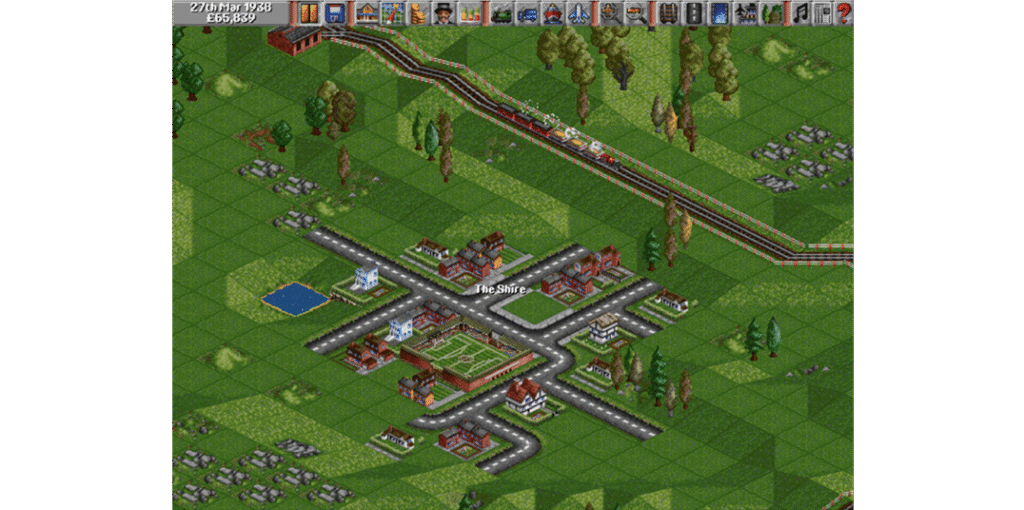
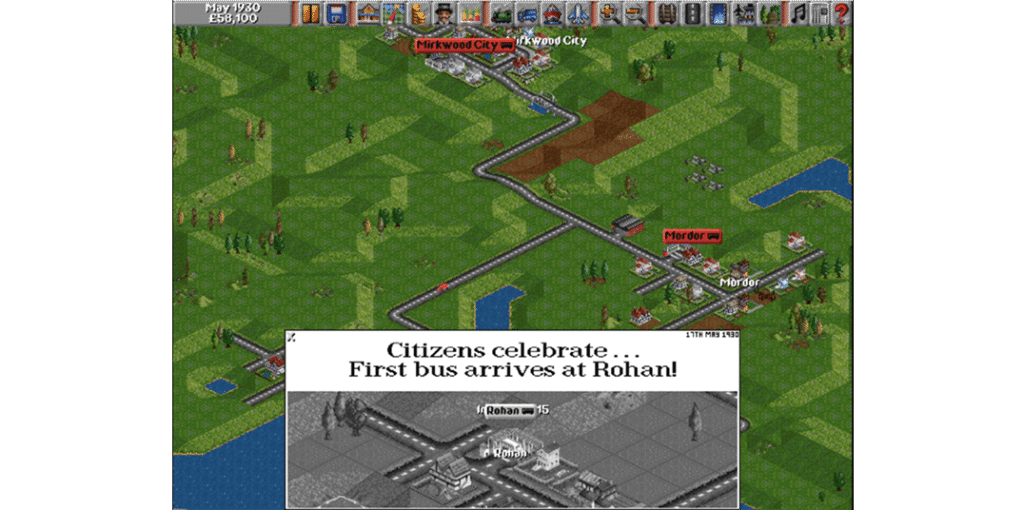
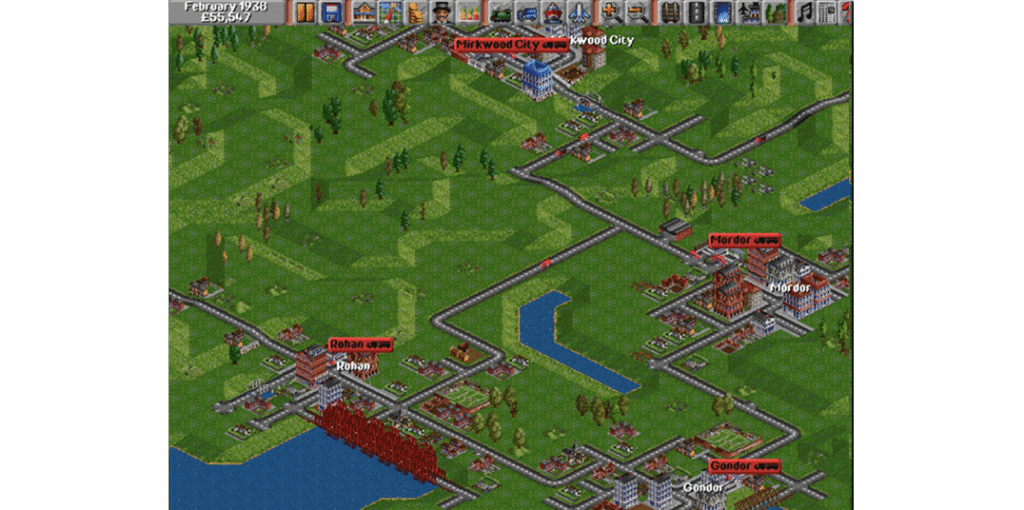
You can change the names of all the towns to reflect where you grew up, or name them after your friends, or try to create a post-industrial revolution Middle Earth, because one does not simply walk into Mordor. One can take the bus.
And the music. A moment for the music. It’s a rolling playlist of chirpy jazz composed by BAFTA-winning John Broomhall, who a cursory search of wikipedia reveals was also the composer to many of the games we’ll feature in the coming weeks. Somehow, the chirpiness never gets on your nerves. And at one point, and do listen out for this, I promise that it’s true, you hear the same chord progression used as Keith Flint drawls the words, “Come…play…my…game,” in the 1997 hit ‘Breathe’ which suggests the tantalising possibility that at least one of The Prodigy used to play this too.
Transport Tycoon would go onto inspire a host of copycat games that took in industries like theme parks, hospitals, prisons and farms, it lives on in a massive public domain update by the name of Open TTD, but this was the original, warts and all, and if you do give it a go, please leave us a message below to tell us how you got on.
This brings back memories. Transport tycoon was one of my favourite games back in the day.
“because one does not simply walk into Mordor. One can take the bus.”
I’d happily pay a monthly subscription based off of these two lines alone.
Best game in the whole world EVER!!!!!!! Listen to the songs a lot