Everton were hit hard by PSR point deductions. But season ticket holder Chris Smith believes PSR actually did the Toffees a favour.
PSR brought Everton to within minutes of relegation. It made the Premier League a sworn enemy at Goodison Park. The PSR/ Everton vendetta became the most devoured conspiracy theory amongst a fanbase that genuinely believes every decision in Liverpool’s favour is the result of a Faustian pact. (It is). But whisper it quietly…PSR has been good for Everton.
During David Moyes’ first Goodison reign, two loaded terms encapsulated the also-ran era: shoestring budget and glass ceiling. Everton were good but not good enough, and worse still, fans only realised how good Everton actually were in retrospect, after they became terrible. Enter Farhard Moshiri whose reign of error gave the Toffees a new, unwanted identity. Wasteful, reckless, clueless, desperate. A laughing stock. The laughing stock. The go-to punchline when anybody needed to refer to a shit football club. But what stopped Moshiri in his tracks?
It wasn’t results. It wasn’t Bill Kenwright. It wasn’t even signing Wayne Rooney, Gylfi Sigurdsson, Davy Klaassen, and Nikola Vlasic in the same summer. It wasn’t the knowledge he was risking the club’s future. It was PSR. The red terror of PSR’s arbitrary limitations was the line in the sand for the Blues. If not a point of no return, a point of several Championship seasons before return, you would have thought… if Everton were lucky. PSR had the power to tell the new emperor he was completely exposed and everybody could see.
Ahead of the 2019/20 season, Everton burned £101m on Alex Iwobi, Moise Kean, Andre Gomes, Jean-Philippe Gbamin, and Fabian Delph. Before wages. A year later, they incinerated £64m on Ben Godfrey, Allan, and Abdoulaye Doucoure, and made imaginary room for James Rodriguez. But by the summer of 2022, the end of Everton’s sowing era was apparent; the time to reap was upon us. Salomon Rondon, Andros Townsend, Asmir Begovic, Dele Alli, and Demarai Gray were acquired for £1.7m. Bargains, you may suggest; a random haul from an expired goods supermarket’s reduced section, you should conclude. The Toffees’ first PSR charge arrived in March 2023, but the message was clear at this point: Everton weren’t just tightening their belts, they were wrenching the tourniquet to cut off the circulation.
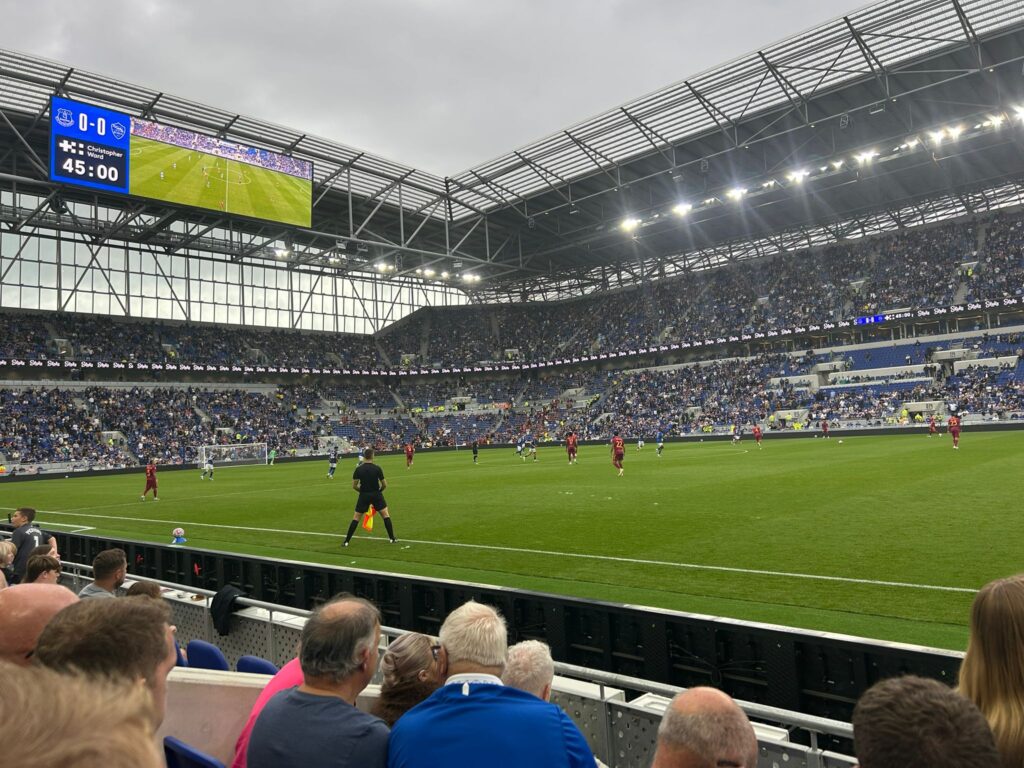
Let’s skip forward to the present day. This summer, Everton have signed Tyler Dibling, Thierno Barry, Kiernan Dewsbury-Hall, Carlos Alcaraz, Adam Aznou, and Mark Travers on permanent transfers for £110m. Last year, they bought Iliman Ndiaye, Jake O’Brien, Tim Iroegbunam, and, irrelevantly, Begovic again, for £42m. Excluding backup goalkeepers – because I simply do not care about them – that’s eight players signed for an average of £19m at an average age of 22. They’re smart signings. They’re Brighton and Bournemouth signings. They’re all players that improve the squad immediately and seem likely to increase in value. More planning, lower risk, better value. This is a sea change in policy.
And then of course, there is hefty expenditure on Jack Grealish. This is no doubt a considerable departure from the penny-pinching pragmatism that informed Everton’s focus on youth, but even a spreadsheet needs colour. We’re talking about a genuinely thrilling player who’s been tested at the highest level and emerged with a treble. Grealish will cost Everton a galling amount but he’ll be indifference insurance for the new owners as they navigate the Toffees’ first year in their new home. His two-assist Man of the Match debut against Brighton underlined this point immediately.
Even the frustrating aspects of Everton’s summer transfer policy have been encouraging. The Toffees had been desperate to strengthen the right side of their attack which had essentially become a haunted position in recent years. Francisco Conceição, Malick Fofana, and Tyler Dibling were identified as main targets; James McAtee, Omari Hutchison, and Abdul Fatawu as backups. Eventually, Dibling signed for £40m including add-ons, a fee lower than a bid previously rejected by Southampton with a sell-on clause reportedly much lower than the 25% they had demanded. Everton held their nerve, took the flak, and made a very sensible investment, further hinting at a club finally getting to grips with itself and with the market, understanding where ambition and budget intersect, at last appreciating value and acknowledging cost.

Everton’s transformation from stupidity to efficiency took root in the decomposition of Moshiri’s vision, through Kevin Thelwell. It has grown in the optimistic bloom of the Friedkin era, but the seeds were planted by PSR. Everton were forced to stop being shortsighted, irresponsible, and profligate, and to start pinching pennies, to sober up, to slap themselves around the face, and to learn how to be a proper football club. That won’t happen overnight, it may take a while – but for the first time since Farhad Moshiri sank his teeth into the club, Everton are on the right track. PSR signalled the end of an error.
You can argue this is all in spite of PSR, that the Premier League dealt with Everton in an excessive and unfair way, and that would be reasonable – it was proven on appeal after all. You could highlight the indefinite can-kicking policy more affluent clubs enjoy and imagine how useful that would have been as Bournemouth’s Matias Vina lined up an Instant Relegation Volley in the dying seconds of the 2022/23 season. By all means despair at a system which enables accountants to drastically impact on-field performance with selling-hotels-to-yourself loopholes. It’s flawed, it’s poorly-written law, and it will negatively impact Everton and similar level clubs in future without doubt.
But this is not a moratorium on PSR, it’s an assessment of its impact on Everton. And the before and after shots look digitally altered. The grey misery and shame of Goodison’s final days have been replaced by the gleam of a bright, new dawn and the renewal of hope that seemed extinct. Of course the new stadium, new owners, and new old manager are big factors, but so too are the consequences of PSR. Everton arrive at this decisive moment in good health – Moyes has been given a competitive budget to rebuild a club that ought to be capable of testing the glass ceiling’s robustness. Like it or loathe it, PSR forcing Everton to confront reality has been vital in reaching this point.