Alex Stewart recounts his experience playing one of the greatest games ever made, Command and Conquer: Red Alert.
There are certain games you play because they’re fun, or challenging, or free in some cellophane stapled to the front of a magazine. And there are some you play because they reframe what a computer game is. Command & Conquer: Red Alert was just such a game.
C&C: RA was a real-time strategy title published in 1996, a prequel to 1995’s Command & Conquer. RTS was hot stuff in the ‘90s with the genre gaining traction after Dune II (1992), also developed by Westwood Studios and incorporating several features that would really take off in C&C: RA, and the classic Warhammer universe title WarCraft: Orcs and Humans (1994). The joys of RTS were twofold: a constantly changing battlescape meant a greater degree of immersion as units shifted and engaged without pause; and the natural scope for multiplayer setups.
The hype for C&C: RA was huge. This was the era of legging it to WHSmith to grab the latest PC Gamer or settling down to be totally weirded out by Patrick Moore’s disembodied head on GameMaster, so while it’s hard to know how I first came across it, this was a game that wasn’t just in the ether, it was the actual ether. Primed by a love of Dune II and blown away by the original Command & Conquer, described by my friend Roger as “to Dune 2 as Doom was to Wolfenstein”, we could not wait to fire up the latest version of the series.
And C&C: RA delivered, eclipsing everything that had come before. Set in a counter-factual universe where Albert Einstein has developed a time machine that allows him to whizz back to 1924 and kill Hitler by shaking his hand outside a prison, C&C: RA sees the Allies and the Soviets wage bloody war over western Europe.
This universe is set out in the introductory sequence, the first of a number of full-motion filmed cut scenes that not only lay out the player’s mission objectives, but flesh out a rich (if slightly insane) timeline (which itself then develops down increasingly bizarre narrative avenues, ending with Tim Curry fighting a robot JK Simmons while George Takei looks on in Red Alert 3, a game which must be played to be believed). Counter-factualism was hot in the early ‘90s too with Robert Harris’ Fatherland coming out four years before C&C: RA, and the game’s makers clearly seized on the opportunity to mess about with the timelines in an imaginative, immersive way.
The title sequence itself is a masterpiece with Frank Klepacki’s Hell March (which starts like a Downward Spiral-era Nine Inch Nails B-side and is perhaps the most iconic game title track until Christopher Tin’s majestic Baba Yetu) thudding and chugging along as helicopters, tanks, and battleships range across the screen like a dictator’s wet dream, ramming home the idea that military muscle and ambition are the key to success.
Cut scenes marked out C&C: RA as an ambitious, world-building game, immersing you either in the precarious world of the Soviets with a violent, drunken, or horny Stalin issuing death warrants and playing drinking games with subordinates, or in the more wholesome, square-jawed Allied command structure – you can probably infer which I enjoyed more.
Indeed, 14-year-old Alex experienced the Soviet campaign narrative as somewhat like a Bond film, including the overtly sexy Russian femme fatale Nadia who at one point straddles Stalin in bed and then later on kills and usurps him (indeed, Goldeneye had come out the year before and straddled – no pun intended – the line between pre- and post-Soviet Union). The Allies had their own female lead, too, Tanya: think Sigourney Weaver in Alien with hints of Black Widow in the Marvel series. You can understand why it wasn’t just the richly rendered combat that enthralled a generation of adolescents, and because of the slightly adult undertones, it all felt like a far more grown-up, fully realised enterprise with actual stakes than most video games.

But narrative alone doesn’t drive a good game and this is where C&C: RA also rose above the pack. While the premise of the gameplay is very similar to Westwood’s precursor RTS titles (build a base, harvest a resource, use that to build more buildings, units, and move along a tech tree), C&C: RA’s range of units and the differences between factions, as well as a few UI upgrades like multiple unit selection and queuing actions, achieved a complexity that makes the game far richer and more interesting.
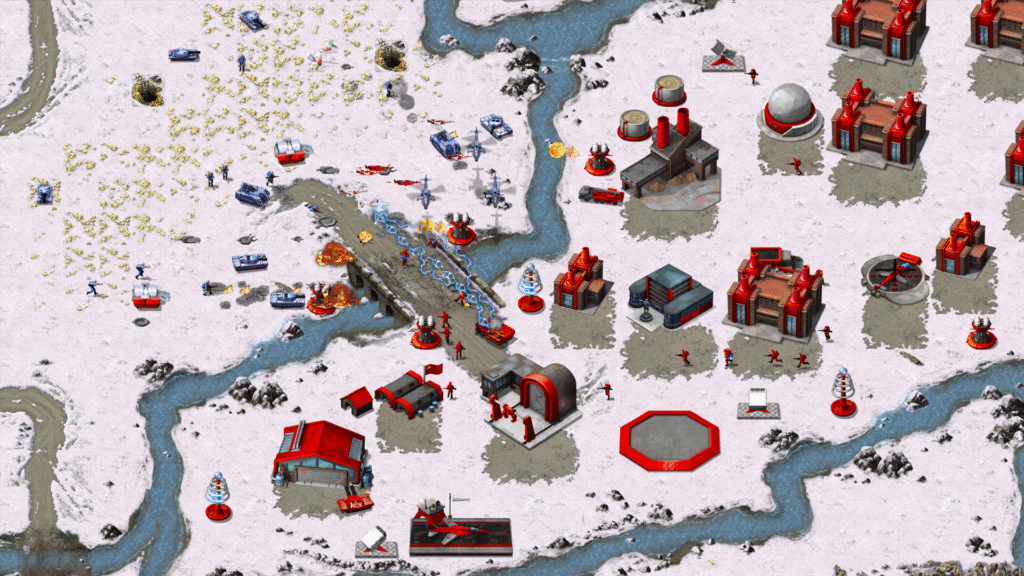
Having chosen your faction, you play a series of missions that see each side seeking to push the other back across the theatre of conflict. Most missions have a choice of maps, selected by clicking on one or other of the arrowed options, so that while each mission in a faction’s campaign has the same objectives, the game play is varied by player choice. The maps depict a terrain that is wintery, rocky, with sparse villages nestled among expanses of pine forest. You can almost hear the crunch of snow under caterpillar tracks.
Generally, you begin by founding a base, which then needs power stations to power other buildings and defensive installations. Gems and ore are harvested by lumbering, generally automated trucks (horribly vulnerable if you don’t pay attention) sent out from ore refineries. Barracks, war factories, and sub pens (Soviets) or naval dockyards (Allies) produce units while the Soviets can also build air strips. Additional infrastructure comes in the form of service depots to repair vehicles, radar installations, ore silos, and defensive structures.
Certain missions also create more specific tasks, like rescuing a spy, or using engineers to sabotage a building, but most just involve battering the enemy until they’re all very dead and here, each faction has its own approach.
The Soviets tend to rely on weight of numbers and machinery, with heavy tanks and V2 rocket launchers, while investing in a tech centre unlocks the accurately named Mammoth tank and flame thrower units. The Soviets’ navy comprises submarines while they can also access air support, including Yak and MIG fighters, a spy plane capacity that reveals parts of the map and can be deployed after a countdown, paratroopers, and para-bombs (almost entirely useless, in my opinion). The Soviets’ most iconic installation is the Tesla coil, which needs a huge amount of electricity but can zap infantry to little jumpy skeletons in one go.
The Allies are nimbler but lighter with skirmishing jeeps called rangers, lighter tanks, helicopters, and a far more varied naval capacity (including cruisers, that can destroy buildings in a few hits but are wildly inaccurate). The Allies can also dig in with gun turrets and pill boxes for anti-tank and anti-infantry capacity respectively.
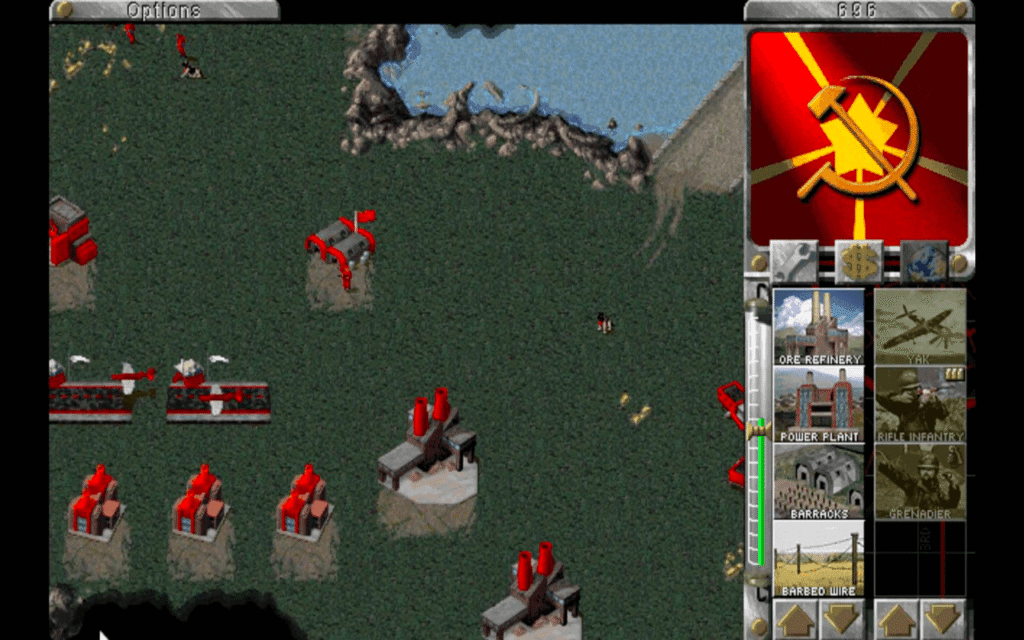
These disparities mean you must play in different ways depending on faction. The Allies tend to strike out from well-defended bases with speed and agility, supporting the infantry with medics to heal rocket troops and riflemen, while the Soviets use more time and intensive resource farming to create vast tank armies that trundle through pretty much anything as V2s whistle overhead to take out opposition emplacements.
RTS games always require a balance between building up a force and striking quickly, while also maintaining an awareness of what is happening across a map (for which the sound effects are very helpful too, with vocalised warnings of attacks on the base or the thumping noise of cruiser shells landing, while the voice track also features the excellent, heavily accented assent of units when you move them around, so OTT they make Sean Connery’s Marko Ramius sound like Moscow native).
C&C: RA absolutely nails this essential conundrum of how much to build up before attacking, and requires a complex balance of resource management, unit building even as war is being waged, and defensive awareness; it’s a heady confection of strategy and action that keeps players locked in, even without the richness of the narrative setting.
But it’s this narrative element that really made C&C: RA stand out. It really was like watching a film where you are then asked (literally, due to repeated fourth wall breaking) to jump in, fulfil a mission, and then get whisked back to watch the film again (again, much like 1997’s FPS Goldenye 007). While the cut scenes can feel clunky now and out-dated in their presentation of women in later versions of the game, C&C: RA really hit the sweet spot between a compelling, complex gaming experience and a narrative framework that immersed the player in the world.
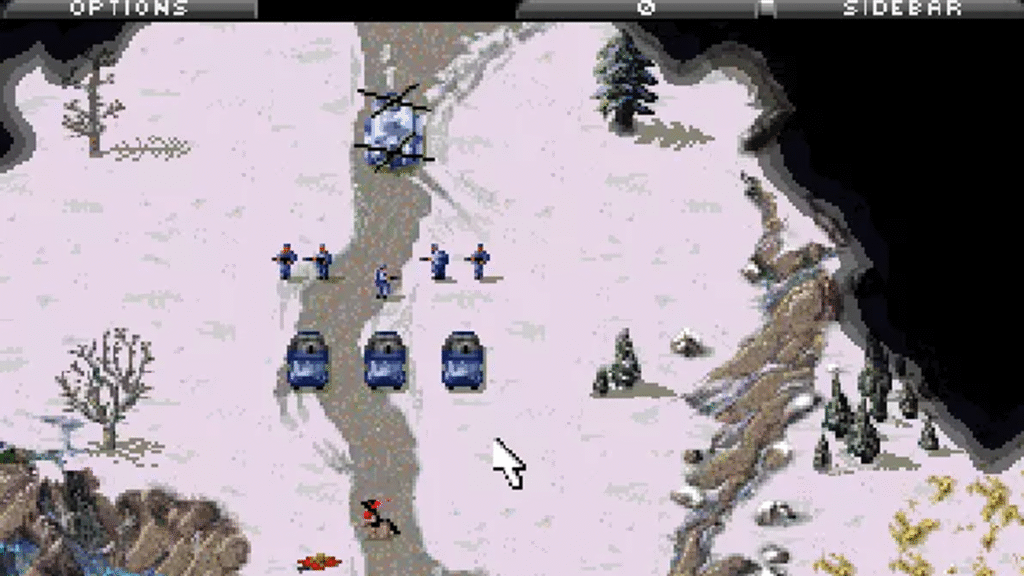
Does the game hold up now? Yes and no: while the RTS elements are still engaging and the game is surprisingly tough at times, it lacks the overarching depth of, say, the Civilisation series, and each campaign can be finished in a few hours of solid, skilful gameplay. The cut scenes are definitely still entertaining (ah Nadia, we meet again) but obviously look a little dated now (and to be honest, seemed so even compared to follow-up games in the series).
Playing C&C: RA, though, is best done for the pure, unadulterated hit of nostalgia you get. My school friend group chat has been alight since I said I was working on this piece, with one friend even digging out the original PC Gamer review, with a universal sense that this game was, genuinely, a game-changer.
For someone who now plays richly-rendered and more complex turn-based strategy games and has access to, you know, actual films, C&C: RA feels very much of its time.
But playing it now also reminded me of how pleasurable it can be to reconnect to a certain time in my life, and how chats about a novel, tricky computer game can induce a flood of recollections among friends who have known each other for decades but can still get excited over things long forgotten and surpassed.
Ah, I loved this game so much – I still go on the map editor every now and again and make a couple of heavily resourced islands and then spend hours making my perfect base whilst the “AI” build loads of tanks and send over pointless air attacks. I then wipe them out when I’m happy with my base – it’s rare I get to indulge my OCD, after all…
I remember creating heavily resources islands with a single file bridge guarded with Tesla coils and concrete walls 😄
YES! 🙌🏻
I loved this game.
I do remember the pathfinding for units was absolutely horrendous and your mouse had to endure a lot of clicking to try and prevent tanks getting lost or randomly distracted, or just stopping. Oh and those pesky ore trucks were the worst for disappearing off behind enemy lines for no reason.
I also remember the game being really difficult as a kid, but then when returning to it later in life it was obvious the key to success is just to build as many tanks as possible. Just loads of tanks. No need for fancy expensive units or buildings. Once you have enough of them you can overload any enemy base.
Wonderful article, thank you. Replayed it relatively recently to renew my love affairs with the allied mine layer and the Soviet subs. Only real frustration is the path finding, otherwise really solid and rewarding game that stands up very well today.
Not to mention the joys of the RULES.INI file.